Building Compensation Bands for Nonprofits on a Tight Budget
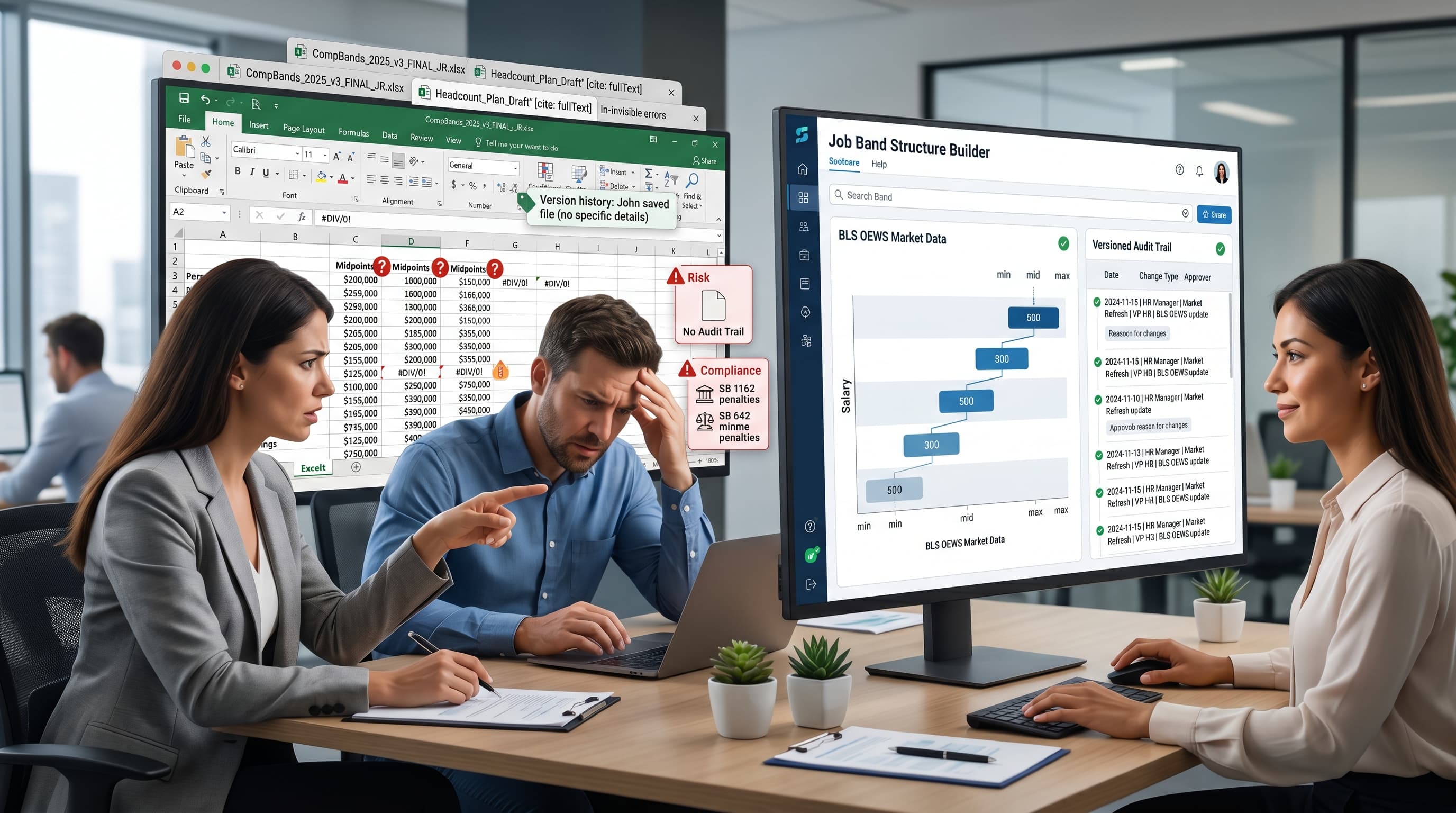
Why Nonprofits Struggle to Build Compensation Bands — and Why That's Changing
Picture this: it's February, and your development director just handed in their notice. You're the HR generalist — perhaps the only HR professional — at a 55-person social services nonprofit in Illinois. You need to post the role within the week, but there's no documented pay range for the position, no approved salary structure, and a finance committee that will want to know exactly why you're proposing the number you're proposing.
You open last year's spreadsheet. The salary listed for the previous director was negotiated three years ago and hasn't been benchmarked since. You have no idea whether it's competitive, equitable relative to your program managers, or compliant with the wave of pay-disclosure rules that have reached 17 states and multiple municipalities — affecting an estimated 65% of U.S. employers, according to Lift HCM.
This scenario plays out constantly in the nonprofit sector. Organizations that would never skip an audit of their grant expenditures routinely manage compensation through informal precedent and individual negotiation. The result is pay disparity that undermines the equity values nonprofits publicly champion — and increasing legal exposure as pay-transparency mandates expand.
This guide gives you a practical, budget-conscious framework for building defensible compensation bands for nonprofits: from defining your job levels to anchoring pay ranges on public benchmarking data to documenting a compensation philosophy your board can approve.
The Nonprofit Compensation Problem Is Structural, Not Just Financial
Tight budgets get most of the blame when nonprofits lack formal pay structures. Budgets are genuinely constrained — but the deeper issue is structural.
Most nonprofits were never designed with a formal job hierarchy. Program roles are built around grants, not an enterprise-wide leveling system. A "Program Manager" at one funder may be a "Project Coordinator" at another, with no consistent criteria separating the two. When compensation lives in individual employment agreements and isn't anchored to documented bands, a few predictable problems compound over time:
Compression. Long-tenured staff get passed by newly hired colleagues when market rates rise and internal equity isn't reviewed systematically. A senior case manager hired four years ago may earn less than a newly hired junior coordinator — not because of performance, but because no one adjusted the anchor.
Internal inequity. Without a written leveling framework, similar roles drift apart in pay based on who negotiated harder, who replaced a higher-paid predecessor, or which program had more funding at the time of hire.
Transparency exposure. If your organization posts roles in California, Colorado, New York, or any of the growing list of jurisdictions requiring salary ranges, an undocumented pay structure means your HR team must invent a "range" in real time — often inconsistently across postings, which creates its own compliance risk.
None of these problems require a large budget to fix. They require structure — specifically, a documented compensation philosophy and a set of defined salary bands applied consistently.
Laying the Foundation: Job Levels Before Pay Ranges
Before you can set a pay band, you need to know what you're banding. Nonprofits should resist the urge to jump straight to salary numbers; the foundation is a clear job architecture.
Step 1: Define your tiers. A 25–100-person nonprofit typically needs three to five job levels, not ten. A workable starting point:
Level 1 — Entry/Coordinator: roles that operate within defined procedures, limited independent judgment, typically 0–2 years of relevant experience.
Level 2 — Program/Specialist: roles that manage a defined scope of work, limited supervision, frequently client-facing or grant-accountable.
Level 3 — Manager/Senior Specialist: roles that supervise staff or manage a function; accountable for results, not just tasks.
Level 4 — Director: functional leadership; strategy and budget ownership within a department or program area.
Level 5 — Executive (ED/COO/CFO): organizational leadership; board accountability.
You may collapse or expand these depending on your headcount and operational complexity. A 30-person organization with two program areas probably doesn't need a Level 5 separate from a Level 4.
Step 2: Map your roles to levels — and to SOC codes. The U.S. Bureau of Labor Statistics Occupational Employment and Wage Statistics (OEWS) program produces annual wage estimates for approximately 830 occupations, drawn from a sample of roughly 1.1 million establishments. These estimates are publicly available and free, and they are the most defensible free benchmark source available to nonprofits on a constrained budget.
BLS OEWS uses Standard Occupational Classification (SOC) codes to organize roles. Mapping your internal job titles to their closest SOC equivalent is not bureaucratic overhead — it's what makes your benchmarking reproducible and auditable. A "Development Director" is most often SOC 11-2033 (Fundraising Managers) or 11-2032 (Public Relations Managers), depending on scope. A "Case Manager" typically maps to SOC 21-1093 (Social and Human Service Assistants) or 21-1022 (Healthcare Social Workers). Document the mapping; you'll use it every cycle.
Step 3: Write level criteria — not job descriptions. Level criteria are the shared standards that determine which level a role falls into, regardless of department. They typically cover: decision-making authority, supervision exercised vs. received, complexity of work, and required credentials or experience. These criteria become the internal rubric your hiring managers and finance committee use to evaluate new positions consistently. For more on the mechanics, see our complete guide to job band structure.
Anchoring Your Bands: Free Benchmarking for Nonprofits
With levels defined and roles SOC-mapped, you're ready to set pay ranges. Here is how to do it using only public data.
Pull OEWS data for your geography. BLS OEWS publishes wage percentiles (10th, 25th, 50th, 75th, 90th) by SOC code at the national level, by state, and for approximately 530 metropolitan and nonmetropolitan areas. Download the May 2025 release tables from bls.gov/oes. The all-occupation annual mean wage in that release is $69,770 — a useful orientation point, not a number to copy directly.
For a specific role, you want the 10th–25th percentile for your band minimum (entry-level or below-market intentional positioning), the 50th percentile (median) for your band midpoint, and the 75th percentile as a ceiling for fully tenured, high-performing incumbents in that level. Adjust for your metro area using the BLS geographic files.
Understand what nonprofit budgets can and can't compete on. Most nonprofits — particularly in social services, arts, and community development — will not match private-sector medians for administrative and operational roles such as HR, finance, IT, and marketing. That's a strategic reality worth naming explicitly in your compensation philosophy rather than hoping no one notices. Many nonprofits choose to position at the 40th–50th percentile of the relevant market for program roles, acknowledge the tradeoff, and supplement with mission alignment, work-life flexibility, and where eligible, Public Service Loan Forgiveness (PSLF).
The important thing is that this decision is documented and deliberate, not an accident of whoever negotiated most recently.
Build a simple band from a midpoint. Once you've selected a target market percentile for each level, calculate your range width. A common approach for nonprofits:
Choose the OEWS 50th-percentile wage for your target SOC/geography as the band midpoint.
Set a range width of 40–50% (meaning the max is 40–50% higher than the min), which is appropriate for roles where the skill gap between a new hire and a fully tenured expert is moderate.
Derive min and max symmetrically from the midpoint.
Worked example (illustrative — anchor on real OEWS data): Suppose the OEWS median annual wage for Fundraising Managers (SOC 11-2033) in your metro area is $72,000. You choose a 40% range width.
Midpoint: $72,000
Min = Midpoint ÷ 1.20 = $60,000
Max = Midpoint × 1.20 = $86,400
That gives you a band of $60,000–$86,400 with a $72,000 midpoint — ready to document, defend to your board, and disclose in postings. Replace $72,000 with the actual OEWS figure for your SOC code and geography.
For Canadian organizations in Ontario or British Columbia, Statistics Canada's Labour Force Survey (Table 14-10-0417-01) provides NOC-based wage percentiles by province and CMA under an open government licence. Consult the specific table for current figures before setting a band.
What Nonprofits Must Document (and Why It Matters Beyond Compliance)
A compensation band is only as defensible as the paper trail behind it. Board members, grant auditors, and regulators may all ask the same question: "How did you arrive at this number?"
Your documentation package for each level should include:
The compensation philosophy — a one-to-two-page statement articulating your market-positioning decision (e.g., "We target the 45th percentile of BLS OEWS data for our metro area"), your internal equity principle, and how you handle exceptions. This document is what your board approves; it gives your ED and HR team a mandate. Our Compensation Philosophy Workbook walks through each section with prompts and a completed example for a mid-size nonprofit.
The benchmarking workbook — the OEWS data you pulled, the SOC mappings, the midpoint calculations, and the range-width rationale. Retain this for at least three years; under Ontario's Employment Standards Act, employers must retain posting and compensation documentation for a minimum of three years after a posting is removed, and building the same habit in the U.S. is simply good practice.
The leveling criteria document — the written criteria for each level, signed off by leadership.
A band-penetration log — where each current employee sits within their band (expressed as a percentage of the midpoint). This is your equity audit starting point. If you want a structured approach to that analysis, the pay equity audit guide covers the methodology.
The organizations most exposed to pay equity complaints are not those with deliberately low pay — they are those with no documented rationale at all. A written structure, even an imperfect one, demonstrates good faith.
Making It Stick: Governance and Annual Maintenance
Building bands once is useful. Maintaining them is what creates durable equity.
Annual review cycle. BLS OEWS releases updated data each spring. Set a calendar reminder: pull the updated tables, compare median figures for your mapped SOC codes to your current midpoints, and flag any band that has drifted more than 5–10% below the current median. Bring recommended adjustments to your finance and HR committees before the budget cycle closes — not after.
Merit and equity increase framework. Define how you use the band structure to guide annual increases. A simple rule: employees below the band minimum receive a priority equity adjustment before merit increases are considered. Employees above the band maximum are ineligible for standard merit increases until the band is repriced (or the role is re-leveled). This protects both the budget and internal equity simultaneously.
Leveling new roles. When a new grant funds a new program role, apply your leveling criteria before setting the salary. Map the role to its SOC code, check where the OEWS median lands, and slot it into the appropriate band. This takes about 30 minutes with a documented framework — versus the two weeks of ad hoc research and committee debate it would otherwise require.
For organizations that want to see how a structured approach compares to the spreadsheet-only workflow that most nonprofits currently rely on — and how the same methodology applies in adjacent sectors — the professional services compensation guide covers similar band-building steps for a comparable small-organization context.
Start With a Philosophy, Then Build the Bands
Nonprofits don't need expensive compensation consulting or enterprise software to build a defensible pay structure. They need three things: a documented compensation philosophy that the board has approved, a consistent leveling framework tied to SOC codes, and pay ranges anchored to publicly available BLS OEWS data.
That foundation — built deliberately and reviewed annually — closes the gap between the equity values your organization communicates externally and the compensation practices it lives internally.
If you're starting from scratch, the Compensation Philosophy Workbook is designed for exactly this moment: a guided framework for writing and documenting your organization's first (or first defensible) compensation philosophy, with prompts specific to the nonprofit context. Download it, work through it with your ED and finance lead, and you'll have the governance anchor your band structure needs before you set the first number. ```
Ready to go beyond the guide?
Build a defensible, BLS-benchmarked band structure in under 30 minutes.