What Are Job Bands? A Plain-English Guide for HR Generalists
If you have ever been asked "what should this role pay?" and felt like you were guessing, job bands are the fix. They turn pay from a series of one-off negotiations into a structure you can explain, defend, and apply consistently. This is the plain-English version — what bands are, the words people confuse, and why a 25-to-250-person company needs them now.
What is a job band?
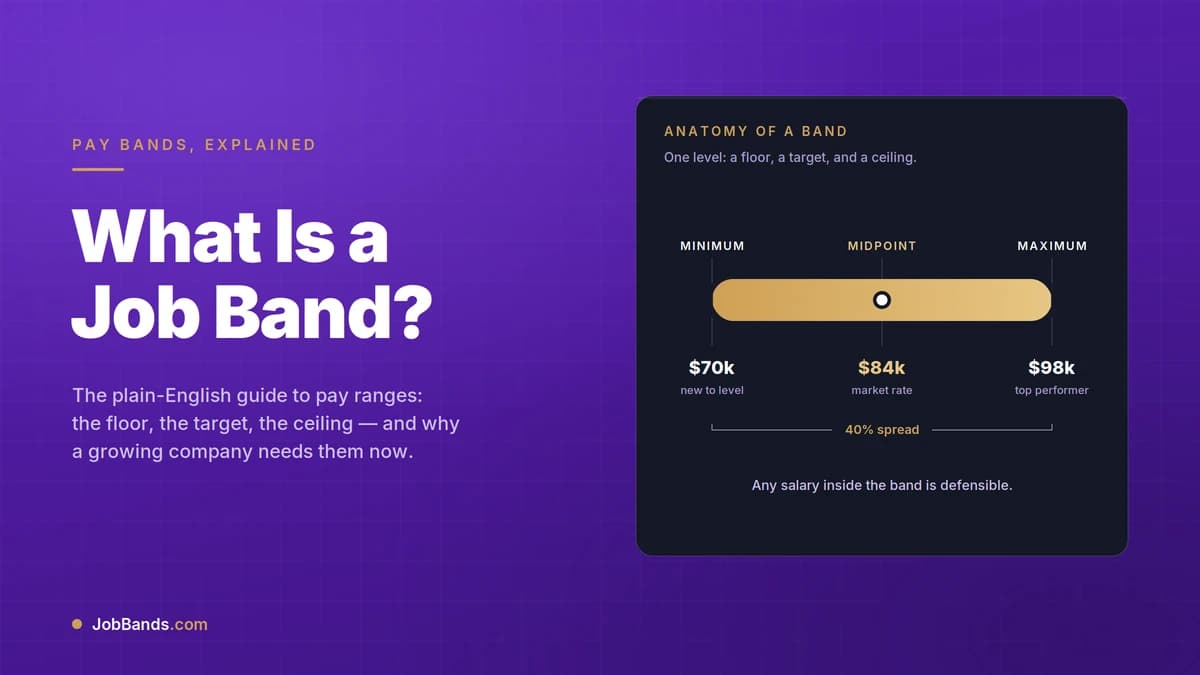
A job band is the approved pay range for a level of work. Instead of a single "right" salary for a role, a band gives you a floor, a target, and a ceiling — and any salary inside that range is defensible.
Each band has three anchor points:
Minimum — where someone new to the level typically starts.
Midpoint — the market rate for someone fully competent in the role.
Maximum — the most you'll pay a seasoned top performer before they need to grow into the next level.
Bands, grades, ranges: the words people mix up
These terms get used interchangeably, which causes endless confusion. Here's the practical distinction:
Range — the min-to-max numbers themselves.
Grade — a narrow range, often used in traditional, highly structured organizations with many tightly defined steps.
Band — a wider range that groups several comparable roles together. Bands trade precision for flexibility, which suits growing companies that can't maintain dozens of narrow grades.
For most companies under 250 people, broad bands are the right call: enough structure to be fair, enough room to handle real people and real markets.
The anatomy of a band
Two properties define how a band behaves:
Spread — the distance from minimum to maximum as a percentage. A 40% spread on a $70,000 minimum reaches about $98,000. Wider spreads give more room to reward tenure without promoting.
Overlap — how much adjacent bands share. Healthy overlap means a strong performer can earn well before being promoted, which keeps people motivated between level changes.
Why bands matter now
Bands used to be a "nice to have" for mid-size companies. Three forces changed that:
Pay transparency law. A growing number of US states and Canadian provinces now require salary ranges in job postings. You can't post a defensible range you haven't built.
Pay equity scrutiny. Bands make it obvious when two people doing comparable work are paid very differently — and give you a structure to fix it before it becomes a complaint.
Hiring speed. When every offer requires a one-off debate about salary, hiring slows. A band gives recruiters and managers a pre-approved range to work inside.
Bands don't remove judgment from pay decisions — they give that judgment a defensible frame.
How bands connect to job leveling
Bands and levels are two halves of the same system. Leveling answers "how senior is this work?" Banding answers "what does that level pay?" You level the jobs first, then attach a pay band to each level. One band can cover many unrelated titles, as long as the scope and impact are comparable.
How many bands do you need?
Fewer than you think. A company of 25–250 people is usually well served by five to eight bands. More than that and you spend your time adjudicating tiny distinctions; fewer and the jumps between levels get too large to manage.
When to introduce bands
The honest answer is "before you're forced to." The best time is when you're still small enough to roll out a structure cleanly — typically somewhere between 20 and 50 employees, or the moment a pay transparency law starts applying to your postings. Waiting until you have a pay-equity complaint or a failed audit means doing the same work under far more pressure.
Next steps
Ready to build your first set of bands? Walk through the method in How to Create Salary Bands from Scratch, estimate the ROI for a team your size, or see how Job Band Builder does the data work for you.
Ready to go beyond the guide?
Build a defensible, BLS-benchmarked band structure in under 30 minutes.